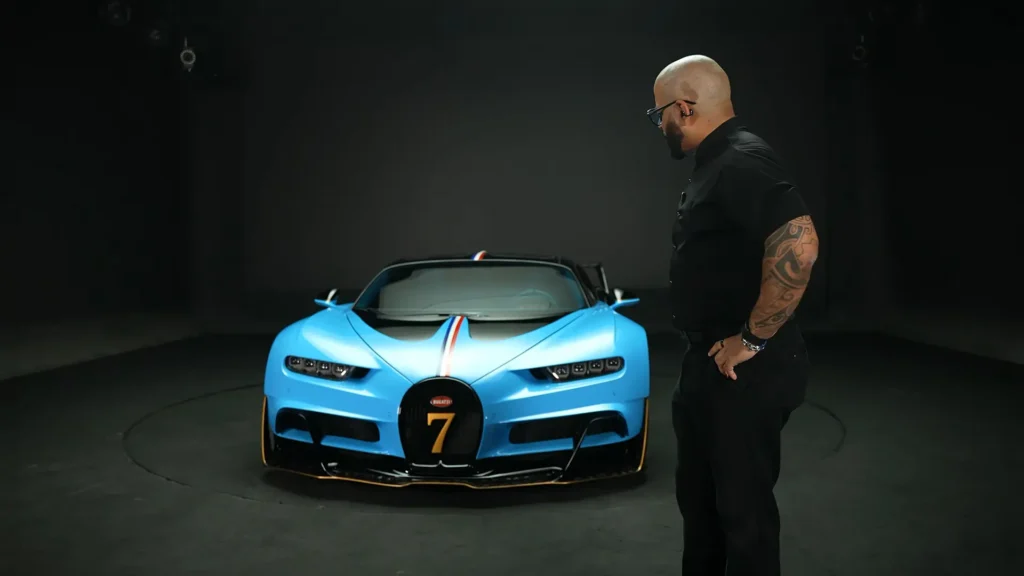
Some cars are built to be admired. Others are built to start a conversation.
The story of Alex G’s Bugatti Chiron Pur Sport, Mat Armstrong, and Venuum became one of those projects that captured the attention of millions of automotive enthusiasts around the world. What started with a damaged Bugatti Chiron Pur Sport developed into something much bigger: an ambitious rebuild, a completely different visual direction, and a radical transformation that would generate millions of views and thousands of opinions across YouTube, social media, and the automotive world.
This wasn’t simply about putting a damaged hypercar back on the road. It became an opportunity to create something different.
From Damaged Bugatti to a Completely New Vision
When Mat Armstrong took on the challenge of rebuilding Alex G’s damaged Bugatti Chiron Pur Sport, the scale of the project quickly became apparent. The Chiron is an extraordinarily complex machine, and rebuilding one is very different from repairing a conventional performance car.
As the project progressed, the team faced the challenge of sourcing the body components required to complete the car. That’s where Venuum entered the story.
Rather than simply attempting to reproduce the original appearance of the Chiron, the project moved in another direction. A new body concept would be created. A new identity. And a very different Bugatti would emerge.
The Venuum Bugatti Chiron Widebody
Venuum approached the Chiron with a philosophy that has defined many of its limited automotive projects: respect the identity of the original vehicle while dramatically changing its presence.
The transformation introduced significantly more aggressive proportions and an entirely different visual character. The objective was not to make the modification invisible. Quite the opposite. The objective was transformation.
The result became one of the most recognizable elements of Mat Armstrong’s Bugatti rebuild and introduced the Venuum name to millions of automotive enthusiasts who had never previously encountered the brand.
Then the Internet Reacted
The reaction was immediate. And it wasn’t neutral.
Early images of the Venuum widebody Bugatti Chiron generated strong opinions throughout automotive communities. Some enthusiasts appreciated the audacity of radically transforming one of the world’s most recognizable hypercars. Others strongly preferred the original Bugatti design.
Automotive publications and online communities began discussing the transformation, with the bodykit becoming one of the most debated elements of the entire rebuild. But radical design has rarely existed without opinion. The important thing was that people were talking.
From Controversy to the Finished Car
There was also an important difference between seeing individual unfinished components during construction and seeing the completed car.
As the project progressed and the Chiron received its final bodywork, paint, stance, and finishing details, perceptions began to evolve. Some enthusiasts who had questioned the transformation during its early stages expressed a more positive reaction once they saw the complete car and understood how the individual elements worked together.
That evolution became part of the story itself. People had watched the car damaged. They watched it being dismantled. They watched new components being installed. They debated the design. And eventually, they saw the complete transformation.
Millions of People Followed the Story
The scale of the audience surrounding the project is difficult to ignore. Mat Armstrong’s completed Bugatti rebuild video accumulated approximately 11 million views, according to third-party YouTube tracking data, while earlier episodes documenting the transformation also reached millions of viewers.
But the significance goes beyond a single video’s view count. The Bugatti appeared across YouTube, Instagram, TikTok, automotive publications, forums, and enthusiast communities. Every stage created another conversation. Every reveal created another reaction.
Throughout that journey, Venuum became increasingly associated with one of the most visible Bugatti rebuild projects on the internet.
Mat Armstrong × Alex G × Venuum
Three different elements ultimately came together:
- Alex G brought one of the world’s most extraordinary hypercars.
- Mat Armstrong brought his approach to rebuilding cars that most people would never attempt to rebuild.
- Venuum brought a radically different design direction.
The result wasn’t simply another restored Chiron. It became a car with its own story—a Bugatti that millions of people watched evolve from accident damage into something completely different.
The Beginning of the VXX Story
The Alex G project also became part of a much larger chapter for Venuum. Venuum continued developing its vision for the Bugatti Chiron VXX, exploring how one of the world’s most recognizable hypercar silhouettes could be transformed through a more aggressive approach to automotive design.
That philosophy would subsequently appear in another highly visible VXX project: the Bugatti Chiron VXX created for Burna Boy.
Different cars. Different specifications. Different owners. But a common design philosophy. For Venuum, VXX represents an exploration of what happens when an already extraordinary platform becomes the starting point for something even more individual.
More Than a Bodykit
Projects of this scale are not simply about adding components to a vehicle. They involve proportions, surfaces, fitment, materials, engineering constraints, and, perhaps most importantly, understanding how every individual element affects the complete silhouette of the car.
With an automobile as recognizable as the Bugatti Chiron, even a relatively small change can dramatically alter its identity. A widebody transformation takes that challenge considerably further. Every new surface becomes part of the overall architecture of the vehicle.
That is why Venuum approaches these projects as complete automotive design concepts rather than collections of individual aftermarket components.
Design Doesn’t Have to Be Quiet
The Mat Armstrong and Alex G Bugatti demonstrated something else: automotive design can generate emotion long before somebody experiences the car in person.
People argued about it. People defended it. People criticized it. People changed their minds about it. Millions watched it. That conversation became part of the identity of the project.
For Venuum, creating limited automotive projects has never been about making every car universally acceptable. It is about giving each project a recognizable identity. Because when you decide to transform an icon, disappearing into the background isn’t the objective.
One Bugatti. Millions of Eyes.
What began as an extraordinary rebuild ultimately became one of the most widely viewed chapters in Venuum’s story.
Alex G. Mat Armstrong. Bugatti Chiron Pur Sport. Venuum.
Different worlds brought together by one extraordinary project. Millions watched. Thousands commented. The automotive world debated it. And the story continues.
We didn’t redesign an icon to go unnoticed. We designed it to be remembered.
VENUUM
DESIGN WITHOUT LIMITS